 Skip-the-line available
 Sans Souci: The King Who Built a Palace to Stop Being King
The vineyard he ordered in 1744, the ten rooms he sketched himself, the grave he dug before the palace was finished, and the potatoes strangers still leave on it.
Most royal palaces are arguments about power. Sanssouci is an argument about escape. When Frederick II of Prussia ordered the bare hillside outside Potsdam terraced into a vineyard in 1744, he was a young king three years into his reign, already famous across Europe as a soldier, and already exhausted by the performance of kingship. The palace he then had built on top of the vines, from his own sketch, in barely two years, was deliberately everything a Prussian royal residence should not be: one storey, ten rooms, no throne room, no queen's apartments, and a French name over the door that translates as 'without a care'. He would spend nearly forty summers there, argue with Voltaire there, and insist, in writing, on being buried there beside his dogs. The story of how that last wish took 205 years to honour, and why visitors now leave raw potatoes on his grave slab, is the best short introduction to Frederick the Great that exists. It is told below, and every scene of it is still visible on the vineyard hill today.
1744: a vineyard before a palace
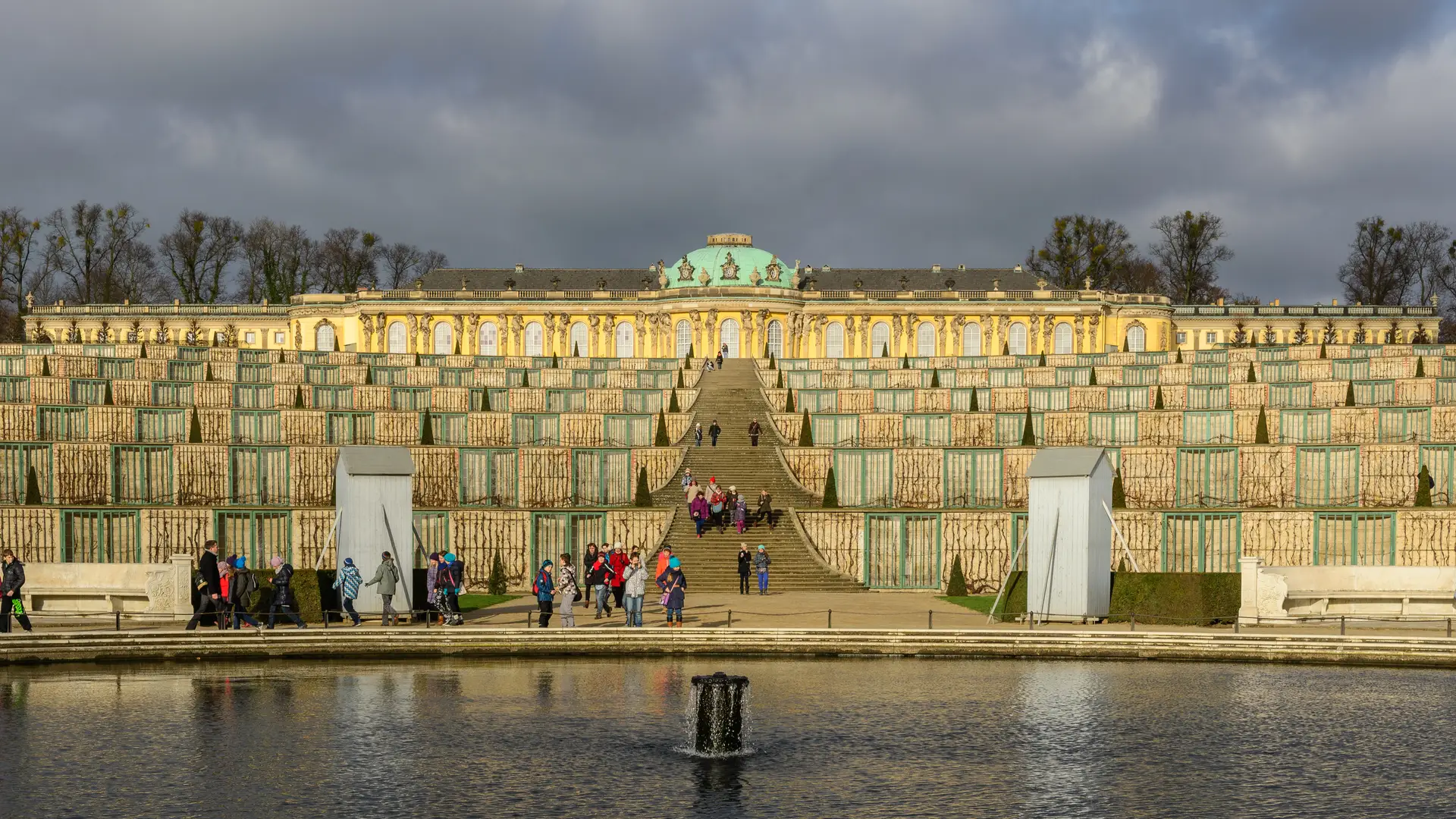
Sanssouci began not as a building project but as a gardening order. In August 1744 Frederick directed that the desolate hill above Potsdam be cut into a great terraced vineyard, and the design that emerged is still the most distinctive thing about the site: broad curved terraces stepping down the south slope, trellised vines brought in from Portugal, Italy, and France trained against the warm brickwork, and fig trees growing in glazed niches set into the retaining walls. A central stair of some 120 steps drops through the terraces to the fountain basin below. It was a working garden as much as an ornament, and that was precisely the point. Frederick was staging an idea he had absorbed from his reading: the ancient ideal of the ruler who withdraws from affairs of state to cultivate his ground.
Only once the vineyard existed did the palace follow. The first stone was laid on 14 April 1745, and the building was finished by 1747, astonishing speed for a royal residence, largely because it was so deliberately small. Frederick had sketched the concept himself and handed it to his architect, Georg Wenzeslaus von Knobelsdorff, to realise: a single-storey Rococo pavilion of just ten principal rooms, sitting directly on the crown of the terraces so that the king could step from his study straight out among the vines. UNESCO's World Heritage description of the Potsdam ensemble singles the palace out as 'the Rococo palace par excellence', and a century later the Prussian court was still honouring the date: the Church of Peace, begun in 1845 at the park's edge, was timed to commemorate the laying of that first stone.
The argument with Knobelsdorff, and what it reveals
The palace's construction contains one famous quarrel, and it is worth knowing because it explains the building. Knobelsdorff, the professional, wanted to raise Sanssouci on a basement storey and push it forward to the terrace edge, so that from the foot of the hill the palace would rise commandingly above the vines, the way a royal residence ought to. Frederick refused. He wanted no stairs between his rooms and his garden; he wanted to walk out of his library and be standing in the vineyard. The result is the oddity every visitor notices from below: seen from the fountain, the palace half-disappears behind the top terrace, a crouching building rather than a soaring one. The disagreement ran deeper than aesthetics, and in 1746 Knobelsdorff was dismissed from the project; Jan Bouman, the Dutch builder, carried it to completion.
Posterity has sided with the king. A palace built to dominate the hill would have been one more Baroque statement in a Europe full of them; the palace Frederick insisted on is instead a machine for private life. The name he gave it was not decoration. The site authority's own visitor text puts it plainly: the name Sanssouci, without a care, 'should be understood as both the primary wish and leitmotif of the king, because this was the place where he most preferred to retreat in the company of his dogs.' At Sanssouci he wrote, composed, and played the flute in the oval Marble Hall, read Greek and Roman authors in a circular cedar-lined library of some 2,100 volumes reached by a passage from his bedroom, and dined with the sharpest conversationalists he could import, Voltaire chief among them. Business of state was for Berlin. The hill was for the other Frederick.
The proof that Sanssouci's smallness was a choice and not a limitation stands two kilometres away at the other end of the park. After the Seven Years' War, the same king built the Neues Palais, a 200-room colossus he himself called his 'fanfaronnade', his piece of swagger, raised to show Europe that Prussia was not broken. Frederick could do vast; he simply refused to live in it, reserving the great palace for state occasions and guests while he returned each summer to his ten rooms above the vines. Walking between the two buildings today is the shortest complete biography of the man available anywhere: the public king at one end of the avenue, the private one at the other, and the visitor free to judge which building he actually meant.
A grave dug forty years early
Here is the detail that separates Sanssouci from every other pleasure palace in Europe: before the palace itself was even finished, Frederick had a burial chamber prepared on the uppermost terrace of the vineyard. He was in his early thirties. His instruction, repeated and put in writing across his life, was that he be buried there in a simple, secluded grave, without ceremony, near his beloved greyhounds, whose small stones still line the terrace beside his. 'Quand je serai la, je serai sans souci', he is recorded as saying of the spot: once I am there, I shall be without a care. The palace was his rehearsal for that condition; the grave was to be its completion. He kept the arrangement in view his whole reign, a private memento mori a few steps from his study windows.
He died at Sanssouci on 17 August 1786, and his wish was promptly ignored. His nephew and successor, unwilling to bury the most famous king in Europe under a garden slab, had the coffin placed in the crypt of the Garrison Church in Potsdam, beside the father Frederick had spent his youth being brutalised by. The irony was total: the king who built a palace to escape his father's Prussia was locked into eternity next to him. And there he lay for a century and a half, while Sanssouci above him hardened into a national monument and the grave he had actually asked for stood empty on the terrace.
The 205-year funeral
The twentieth century then took Frederick's coffin on one of the strangest journeys in European funerary history. In the final years of the Second World War, with Potsdam under the bombs, the sarcophagi of Frederick and his father were moved for safekeeping: first to a bunker near Geltow, then down a salt mine at Bernterode, where American forces discovered them in 1945. From there the coffins travelled west, spending time in Marburg, before coming to rest in 1952 at Hohenzollern Castle in the Swabian hills, the ancestral seat of the dynasty, several hundred kilometres from the vineyard where Frederick had asked to lie. Through the Cold War his grave was thus doubly displaced: the terrace at Sanssouci stood in East Germany, his coffin in the West, and the simple burial he had specified in 1744 seemed permanently out of reach.
German reunification unlocked it. On the night of 17 August 1991, 205 years to the day after his death, Frederick's coffin was brought back to Sanssouci and lowered into the prepared chamber on the uppermost terrace, after dark and without pomp, exactly as his will had specified. The choice to do it at night was deliberate fidelity: no state theatre, no oratory, a burial at last on the king's own terms. Today the spot is marked by a plain stone slab bearing only his name, set flat in the grass beside the east wing of the palace, with the greyhounds' stones in a row nearby. It is free to visit whenever the park is open, and it is permanently, mysteriously decorated, which brings us to the potatoes.
Why there are potatoes on the grave
Stand at the grave slab for ten minutes and you will almost certainly see it happen: a visitor steps up and places a raw potato on the stone, sometimes several, occasionally one wearing a little paper crown. The tribute refers to the story every German schoolchild learns, of Frederick as the Kartoffelkoenig, the potato king. Eighteenth-century Prussian peasants, the tale runs, refused to plant the strange tuber, so Frederick resorted to theatre: he had royal guards posted around his potato fields by day, signalling that here was a crop precious enough to guard, and had the guards withdrawn at night so that enterprising locals could steal the seed potatoes and plant them as their own. Reverse psychology as agricultural policy. Whether or not it happened quite that way, Frederick genuinely did push potato cultivation through a series of decrees, and the vegetable became a foundation of the Prussian diet in his lifetime.
Historians are cheerfully clear that the legend outruns the record: the potato had reached Prussian gardens before Frederick was born, promoted by his predecessors, and the guarded-field trick is unverifiable folklore. It makes no difference at the graveside. The potatoes keep arriving because the story compresses everything people want to believe about this particular king, cunning applied to the welfare of ordinary subjects rather than to conquest, and because there is something irresistible about honouring the builder of a Rococo palace with the plainest food in Europe. The palace administration periodically clears the slab; it repopulates within days. Frederick, who asked for a burial without ceremony and got instead an endless, informal, vegetable-based one, would perhaps have seen the joke. He is, at least, finally where he asked to be: on his terrace, above his vines, sans souci.
Frequently asked
What does Sanssouci mean?
It is French for 'without a care' or 'without worry'. The name was Frederick the Great's programme for the palace: a ten-room retreat where he could live privately among his books, his music, and his dogs, away from the Berlin court.
Why do visitors leave potatoes on Frederick the Great's grave?
As a tribute to his promotion of potato cultivation in Prussia, and to the legend that he tricked wary peasants into planting the crop by having his potato fields conspicuously guarded by day and left unguarded at night so the seed potatoes would be stolen.
Is the potato story true?
Only partly. Frederick did issue decrees promoting the potato, but the crop had reached Prussia before his reign and the guarded-field trick is folklore. Historians treat it as a myth that stuck because it fits his reputation for cunning.
Where exactly is Frederick buried?
Under a plain stone slab on the uppermost vineyard terrace at Sanssouci, beside the palace's east wing, with the graves of his greyhounds alongside. He was reburied there on the night of 17 August 1991, 205 years after his death, as his will had asked.
Why was he not buried at Sanssouci when he died?
His successor overrode his written wish and placed the coffin in the crypt of Potsdam's Garrison Church next to his father. Wartime evacuations later moved it via a bunker near Geltow and the Bernterode salt mine to Hohenzollern Castle in 1952, before the 1991 return.
Do I need a ticket to see the grave?
No. The grave lies in the free part of the park on the upper terrace, open daily from 8 am until dark. Only the palace interior requires a timed ticket.