 Skip-the-line available
 What to See Inside Sanssouci Palace: A Room-by-Room Guide
The Voltaire Room, the Marble Hall, Frederick's flute concerts, and the tomb on the upper terrace, in the order the tour route takes you.
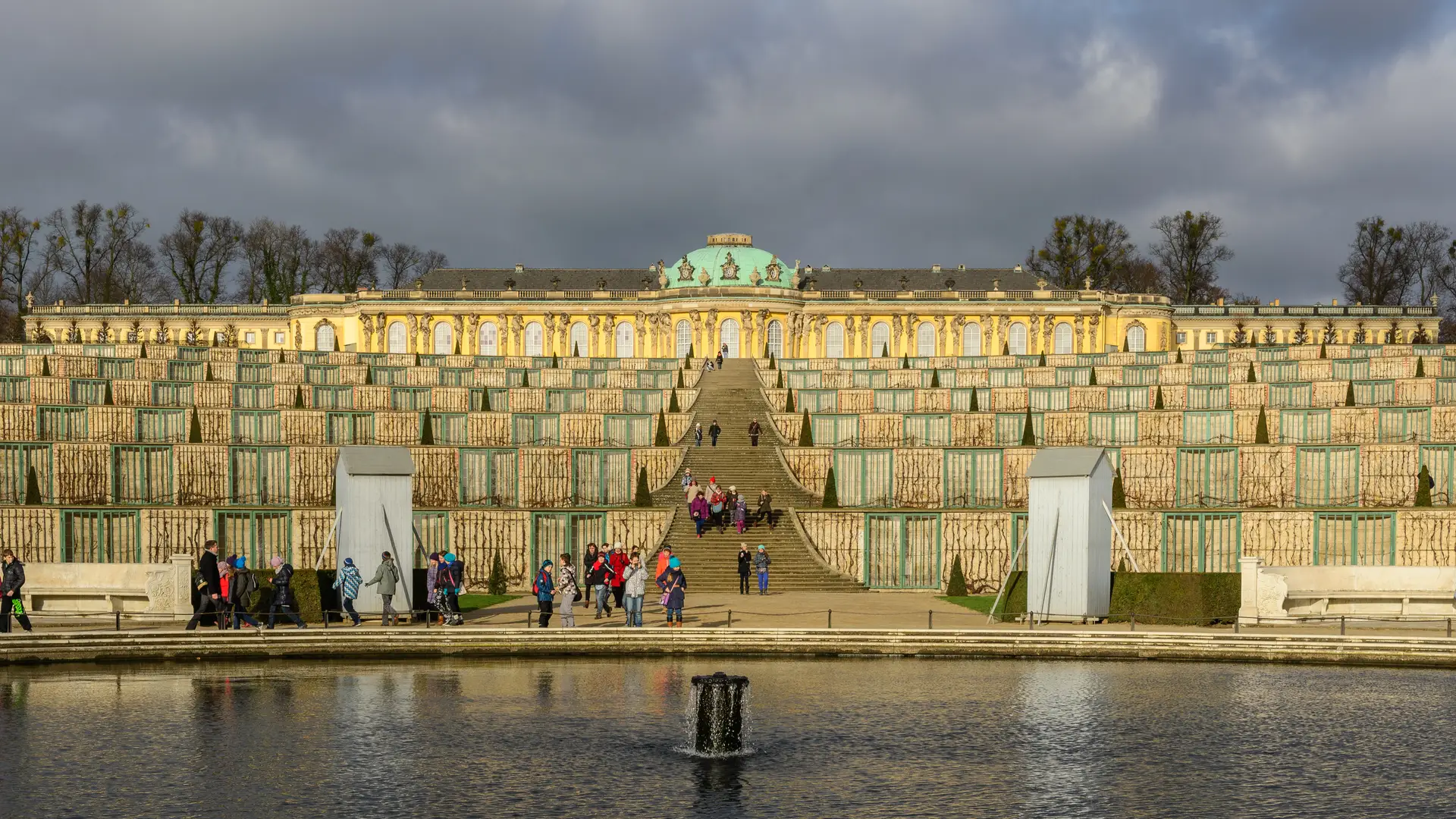
Sanssouci is a small palace by any royal standard, just ten main rooms across a single storey, and that intimacy is the whole point. Frederick the Great wanted a private retreat, not a court, and every interior decision reflects that intention. Visitors follow a fixed one-way route that takes about 45 to 60 minutes to walk through carefully, exiting through the kitchen and out onto the upper vineyard terrace where Frederick is buried. This guide takes you through the rooms in the order you will see them, calls out the details most worth pausing for, and explains why the famously named Voltaire Room is in some ways a polite eighteenth-century fiction.
The Marble Hall: the oval reception
The Marble Hall is the centrepiece of Sanssouci and the room every visitor enters first after the vestibule. It is deliberately oval rather than rectangular, a Rococo conceit that softens the geometry of the otherwise symmetric building and refuses the hierarchical sight lines of a baroque state palace. The floor is laid in white and yellow Carrara marble in a radiating pattern; the eight Corinthian columns lining the walls are Carrara as well; and the ceiling fresco, by Johann Harper, depicts Venus and the Graces in a deliberately playful counterpoint to the formal architecture below. Light floods in through the south-facing French doors that open directly onto the vineyard terraces, and on a sunny day the white marble glows with reflected light from the gardens. The hall was used for small dinners and concerts, never for large court receptions, and that scale is felt immediately on entering.
The Audience Room and Frederick's everyday life
Adjacent to the Marble Hall is the Audience Room, where Frederick conducted what business he could not avoid bringing into his retreat. The room is small, decorated in green damask with delicate Rococo carvings in the wall panels, and centred on a single writing desk rather than a throne. The contrast with the cavernous audience halls of contemporary Versailles or Schoenbrunn is the most direct visual evidence of Frederick's character: even when receiving, he preferred a desk and a chair to a dais and a throne. Look for the wall carvings of musical instruments, vines, and grotesques by the brothers Johann Michael and Johann Christian Hoppenhaupt, who carried out most of the interior carving at Sanssouci and whose work defines the Frederician Rococo style. The room also contains some of the few surviving examples of Frederick's working furniture, modest by court standards and consistent with the king's stated preference for utility over display.
The concert hall: where Frederick played the flute
Frederick the Great was a serious amateur flautist and composer who wrote more than 120 flute sonatas, and the concert hall at Sanssouci is the room where he performed almost daily during his summer residencies. The walls are painted soft yellow and decorated with carved trellises, putti, and flowering vines by the Hoppenhaupt brothers in the most exuberant Rococo style found anywhere in the palace; the floor is parquet in a star pattern; and three crystal chandeliers light the room in the evening. Frederick's own flute, made by Johann Joachim Quantz, his teacher and the most celebrated flute-maker of the eighteenth century, is no longer in the room itself but several period instruments are displayed nearby. Concerts at Sanssouci typically included Quantz, Carl Philipp Emanuel Bach (who was Frederick's court composer), and the king himself on flute.
The Voltaire Room: a polite eighteenth-century fiction
The Voltaire Room is the most famous room at Sanssouci and also the one whose name requires the most explanation. Voltaire did indeed stay at Sanssouci between 1750 and 1753 as Frederick's guest and a kind of philosopher-in-residence, and the relationship between the two men, brilliant, mutually flattering, and ultimately bitter, is one of the great stories of the Enlightenment. But Voltaire almost certainly did not sleep in this specific room, which was decorated in its current exuberant style, with carved monkeys, parrots, and tropical fruits climbing the yellow walls, after Voltaire had already left Prussia. The name became fixed in nineteenth-century guidebooks and the site authority retains it for historical reasons. The room is worth pausing in for the carvings alone, which are the most exuberant zoological work in any German palace interior of the period.
The library, the bedchamber, and the upper terrace
The library is a small hexagonal room lined floor to ceiling in cedarwood, with bronze fittings and gilded Rococo carvings, and contained Frederick's personal collection of roughly 2,100 volumes, almost all of them in French. The bedchamber, the last room on the visitor route, was famously called 'small but exquisite' by Voltaire and contains a single bed, a writing desk, and the chair in which Frederick is believed to have died in August 1786. After exiting through the small kitchen, the route emerges onto the upper vineyard terrace, and a short walk takes you to Frederick's tomb. The king asked to be buried beside his greyhounds on this terrace, but his wish was overridden after his death and his remains were placed in the garrison church in Potsdam; they finally returned to this spot in August 1991, more than two hundred years later, when the German state honoured the original request.
Frequently asked
How long does the interior tour take?
Between 45 minutes and an hour at a comfortable pace, following the one-way route through ten rooms ending at the kitchen exit onto the upper terrace.
Did Voltaire really sleep in the Voltaire Room?
Probably not in that specific room as it now appears, but he did live at Sanssouci between 1750 and 1753 as Frederick's guest. The room's current decoration post-dates his stay.
Is there an audio guide?
Yes. the site authority provides a multilingual audio guide that walks you through the rooms in order, with detail on the carvings, paintings, and Frederick's personal use of each space.
Can I take photographs inside?
Photography without flash is permitted in most rooms. Tripods and selfie sticks are not allowed and some rooms with light-sensitive textiles prohibit photography entirely.
Where is Frederick the Great buried?
On the upper vineyard terrace immediately above Sanssouci, in a simple stone tomb. His remains were placed there in August 1991 after a long post-war journey.
Why do visitors leave potatoes on the tomb?
Frederick the Great is popularly credited with promoting the potato as a staple crop in Prussia in the 1740s and 1750s, helping the country survive periodic famines. Visitors leave potatoes as a small tribute to that legacy.
Is the kitchen part of the visit?
Yes, the small palace kitchen forms the exit point of the tour and is preserved with its original copper cookware and tile work.
Are the carvings original?
Most of the carved Rococo decoration is original eighteenth-century work by the Hoppenhaupt brothers and their workshop. Damage from WWII and post-war neglect has been carefully restored by the site authority over decades.
Is the visit accessible?
The single-storey layout makes much of Sanssouci more accessible than other Potsdam palaces, but the historic thresholds and surfaces have inherent limitations. the site authority provides accessibility information on request.