 Skip-the-line available
 Voltaire at Sanssouci: Three Years of Genius and Bad Blood
Europe's most famous writer moved in with Europe's most famous king in 1750. It produced the best dinner conversation of the century, a room carved with parrots, and an arrest warrant.
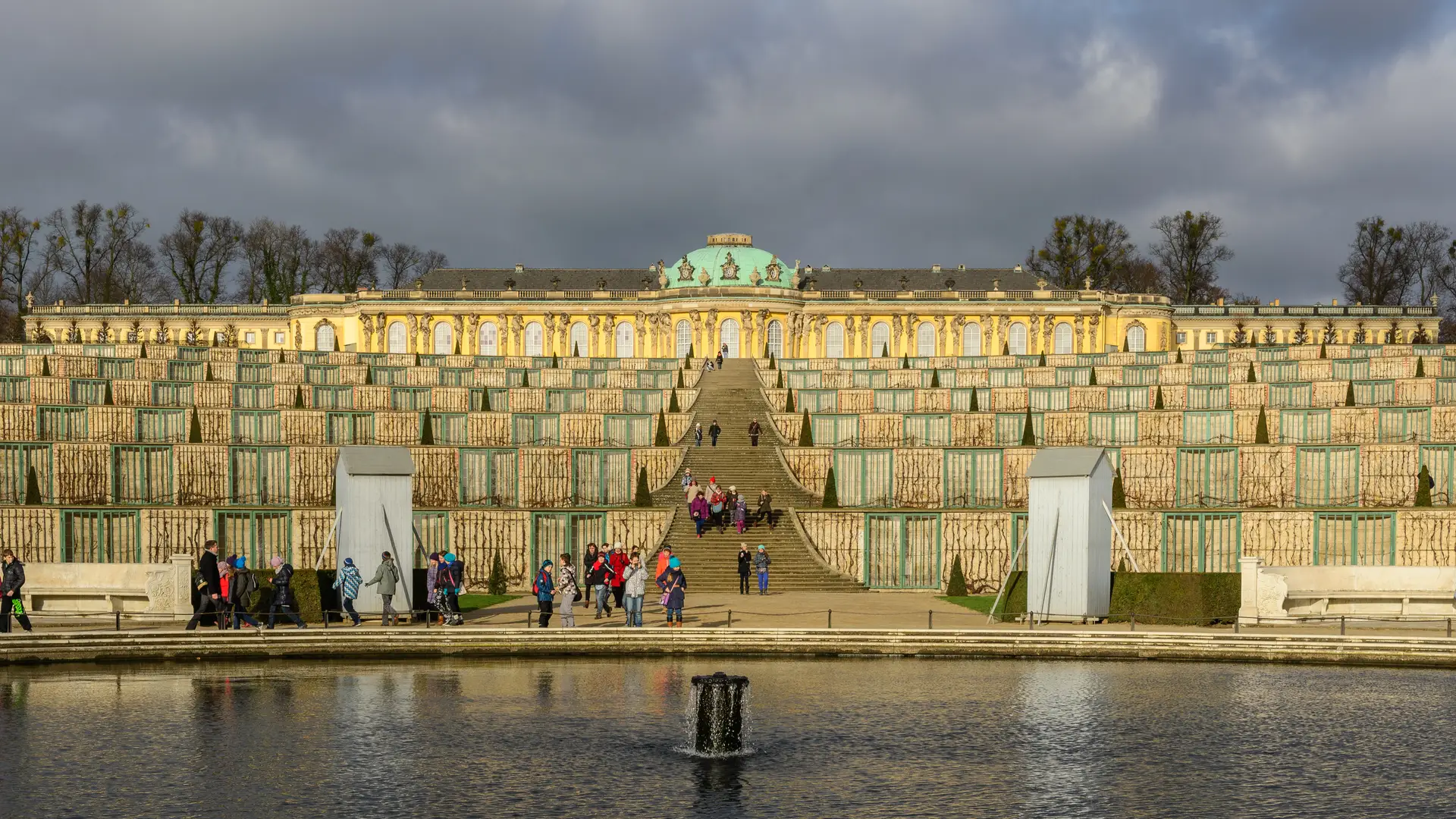
Of all the facts a World Heritage listing could choose to mention about a palace, UNESCO's entry for the Potsdam ensemble reaches for this one: 'Voltaire stayed at the Sans-Souci Palace, built under Frederick II between 1745 and 1747.' It is the right instinct. The three years from 1750 to 1753, when the most celebrated writer in Europe lived as the guest of its most watched king, are the reason Sanssouci matters beyond architecture: the little palace on the vineyard was briefly the dinner table of the Enlightenment, the place where the century's sharpest tongue and its most powerful admirer tried, and spectacularly failed, to share a roof. The episode ended with Voltaire fleeing Prussia and being detained on the king's orders in Frankfurt, and it left behind one of the strangest and loveliest rooms in the palace: a chamber of yellow lacquer crawling with carved parrots, cranes, and monkeys that bears the philosopher's name to this day. This is the story a visitor should carry through those ten rooms.
The invitation: a king collects a philosopher
Frederick had been courting Voltaire for years before Sanssouci existed. As crown prince he had initiated a correspondence with the philosopher in flawless, flattering French; as king he kept up the pursuit, and Voltaire had twice visited Potsdam briefly before finally accepting a standing invitation in the summer of 1750. The terms were gilded: a chamberlain's key, a royal pension, a seat at the king's private table, and the run of the palaces. For Frederick, the acquisition was the crown of a lifelong project, a court conducted in French, devoted to music, poetry, and philosophy, and pointedly unlike the parade-ground Prussia of his father. Sanssouci, finished three years earlier, was that project in built form, and Voltaire was to be its resident genius.
The role came with a job description both men politely pretended was an honour. Voltaire's actual function was editorial: Frederick wrote verse in French, constantly and at length, and Voltaire was to polish it. The arrangement contained its own detonator. Voltaire privately joked about being handed the king's dirty linen to wash; the king, no fool, heard of it. But in the first months none of that mattered. Voltaire was installed in the palaces of Potsdam, dined nightly with the king, and wrote to friends in Paris with genuine wonder about a monarch who talked philosophy like a man of letters. For a season, the arrangement Europe gossiped about actually worked.
It helps to grasp how unprecedented the household was. Kings kept court poets and salaried flatterers; no monarch had ever installed the most dangerous pen in Europe at his own dinner table as something close to an equal. Voltaire was then in his mid-fifties, an international celebrity whose plays, histories, and lampoons had already got him exiled from Paris more than once, and his decision to accept a German king's hospitality was itself a scandal in France. Frederick, twenty years younger, had grown up idolising French letters against the will of a father who despised them, and possessing Voltaire in person was the ultimate vindication of that rebellion. Sanssouci gave the experiment its stage: a palace with no queen's wing, no council chamber, and no protocol, purpose-built for evenings of unguarded talk. Both men later described the first Potsdam summer in the language of infatuation, and infatuation, as the next three years demonstrated, was exactly the problem.
The suppers in the Marble Hall
The institution at the heart of the Sanssouci years was the king's supper table. Frederick assembled a small circle of philosophers, wits, and scientists, and over long evenings in the palace's oval Marble Hall the conversation ran in French across religion, poetry, war, and gossip, with a freedom that would have been unprintable anywhere else in Prussia. Voltaire was the undisputed star. The king, who had built Sanssouci precisely as a stage for private intellectual life, ten rooms, no throne, no court etiquette, had in Voltaire the one guest whose fame matched his own, and contemporaries understood the suppers as a kind of ongoing duel: two of the quickest minds in Europe performing for each other nightly.
The setting deserves the visitor's attention, because the palace was engineered for exactly this scale of life. The Marble Hall sits at the centre of the enfilade, oval beneath its dome, with the concert room beside it where Frederick played his flute in the evenings. A few steps away, through a narrow passage from the king's bedroom, lies the circular library, cedar-panelled and lined with roughly 2,100 volumes, the Greek and Roman classics and the French moderns, Voltaire's own works naturally among them. It is a reading room for one person: the king admitted almost nobody. That contrast, the sociable hall and the hermetic library a corridor apart, is the whole double life of Frederick in ten metres, and the Voltaire years were its high point.
The room with the parrots
In the guest wing of the palace is the room every tour lingers in: walls of yellow lacquer overlaid with astonishing carved and painted wooden ornament, monkeys, parrots, cranes, storks, garlands of fruit and flowers, executed in 1752 and 1753 by Johann Christian Hoppenhaupt the Younger. It has been known for two centuries as the Voltaire Room. The decoration is often read as a sly portrait of the guest, the chattering parrot among them, and whether or not the joke was intended, the room is the most exuberant single interior in the palace, Rococo at its least restrained, a fantasy of the tropics installed in Brandenburg.
Honesty compels a footnote that the palace's own historians are careful about: it is doubtful Voltaire ever actually slept in the room that carries his name. During his Potsdam years he was lodged primarily in the Potsdam City Palace, and the Sanssouci guest rooms hosted a rotating cast of the king's circle. The room was fitted out in his honour late in his stay, and the name attached itself permanently after his departure. None of this diminishes it. The Voltaire Room is best understood not as the philosopher's bedroom but as Frederick's monument to the relationship, commissioned, with exquisite timing, at the exact moment the relationship was falling apart. Stand in it with that chronology in mind and the gaiety of the carving turns faintly elegiac: the king was decorating a shrine to a friendship he was simultaneously destroying at the dinner table, and the parrots have been repeating the joke ever since.
The quarrel: how it curdled
The collapse came from stacked resentments. Voltaire, bored and expensively idle, entangled himself in a shady financial speculation and a resulting lawsuit that embarrassed the court. The king's verse kept coming, and the flattery required to receive it grew heavier. But the fatal quarrel was intellectual. Maupertuis, the French scientist Frederick had installed as president of his Berlin academy, crushed a junior scholar in a scientific dispute, and Voltaire, siding with the underdog, published an anonymous satire that made Maupertuis, and by extension the king's academy, ridiculous before all Europe. Frederick, who had personally ordered the pamphlet suppressed, watched his house guest mock his court from inside it. Copies were burned in Berlin. The suppers were over.
Voltaire left Prussia in the spring of 1753, and the departure turned into the scandal of the decade. At Frankfurt, on Frederick's instructions, the travelling philosopher was detained by the king's agents for weeks, ostensibly to recover a volume of Frederick's private poems that Voltaire had carried off in his luggage, verse compromising enough that the king would not risk it circulating. The spectacle of Europe's most famous writer held in a hotel over a book of royal poetry was gleefully reported everywhere, and it fixed the episode in legend. The two men never met again. Tellingly, though, the correspondence that had started it all resumed within a few years and continued to the end of Voltaire's life: they could not live in the same palace, and could not quite let go of each other either.
Reading the palace through the Voltaire years
For the visitor, the Voltaire story turns Sanssouci's ten rooms from a decor tour into a drama with a floor plan. The Marble Hall is the supper table where the performance ran nightly; the concert room is the king's other voice, the flute he played when words were put away; the library is the sealed chamber where Frederick read alone the authors he and Voltaire argued over at dinner; and the Voltaire Room in the guest wing is the relationship's gorgeous, ironic tombstone, carved while the friendship died. The palace visit is self-guided with a multimedia app available in a dozen languages, and entry is bound to a fixed time slot, so the practical advice is simple: take an early slot, and give the guest wing the ten unhurried minutes the parrots deserve.
A few practicalities for pilgrims of this particular story. The palace closes on Mondays, and its daily ticket quantities are limited, so the slot is worth securing in advance on any busy date. The rooms in the Voltaire chapter, the Marble Hall, the concert room, the library, and the guest wing, come in the natural order of the enfilade, so no special routing is needed; the app narration covers them room by room. Before or after your slot, walk the terraces: the park is open from 8 in the morning until dark and free to enter, and the view Voltaire would have had from the top terrace, down the vines to the fountain, is unchanged. Completists can extend the theme beyond the park; the avenue named Voltaireweg, connecting Sanssouci toward the New Garden, is listed among the components of the UNESCO World Heritage property, a street-sign-sized monument to how thoroughly three stormy years attached the philosopher's name to this landscape.
It is also worth stepping back onto the terrace afterwards and weighing what the episode says about the place. Frederick built Sanssouci to live 'without a care' among equals of the mind, and the Voltaire years proved the dream both real and impossible: real, because for three years the little palace genuinely was the most interesting address in Europe; impossible, because a king cannot have equals, and both men knew it. UNESCO's citation of Voltaire's stay in its description of the World Heritage property is, in that light, exactly right. The vineyard palace's claim on posterity is not gilding or symmetry. It is that the Enlightenment itself once sat at its dinner table, quarrelled, and stormed out through the park.
Frequently asked
When did Voltaire live at Frederick the Great's court?
From the summer of 1750 to the spring of 1753. He came as the king's honoured guest with a chamberlain's key and a pension, and his duties included polishing Frederick's French verse.
Did Voltaire actually sleep in the Voltaire Room?
Probably not. He lodged mainly at the Potsdam City Palace, and the famous yellow room in Sanssouci's guest wing, decorated with carved parrots and monkeys by Hoppenhaupt the Younger in 1752-53, was named for him afterwards. It can be seen on the palace visit.
Why did Voltaire and Frederick fall out?
A stack of grievances, capped by Voltaire's anonymous satire mocking Maupertuis, the president of Frederick's Berlin academy. The king had the pamphlet burned, and Voltaire left Prussia in 1753.
Was Voltaire really arrested?
He was detained for several weeks in Frankfurt in 1753 by Frederick's agents, who demanded the return of a volume of the king's private poetry Voltaire had taken with him. The affair scandalised Europe, and the two men never met again.
Can you visit the rooms from this story today?
Yes. The Marble Hall, the concert room, the library, and the Voltaire Room all lie on the standard self-guided route through the palace, which is visited with a timed-entry ticket and an optional multimedia app in twelve languages.