 Skip-the-line available
 Walking Sanssouci Park: Every Palace, in the Right Order
Nearly 300 hectares, more than a dozen royal buildings, one two-kilometre axis. How the park actually fits together, and the walking order that wastes none of your day.
First-time visitors consistently make the same mistake in Sanssouci Park: they treat it as a palace with a garden attached, when it is really a designed landscape of nearly 300 hectares in which Sanssouci Palace is only the most famous of more than a dozen royal buildings. The park's east-west axis runs for more than two kilometres, from the vineyard terraces at one end to the Neues Palais at the other, and the buildings along it were added by four successive rulers over a century and a half. UNESCO inscribed the whole ensemble, together with the other Potsdam and Berlin parks, as a single World Heritage property in 1990: 500 hectares of parkland and 150 buildings raised between 1730 and 1916. You cannot see all of it in a day. What you can do, with a little orientation, is walk the park in an order that puts every worthwhile interior and viewpoint on a single unbroken line, with no doubling back. This guide is that orientation.
The shape of the park: one long line with two anchors
Sanssouci Park is organised around a single spine, the Hauptallee, which runs east to west for more than two kilometres. At the eastern end sits Sanssouci Palace on its terraced vineyard hill, the intimate ten-room retreat Frederick the Great built between 1745 and 1747. At the western end stands the Neues Palais, his colossal post-war statement piece, its high tambour dome visible from far down the avenue. Almost everything else in the park hangs off this line or sits a short detour from it: the Picture Gallery and the New Chambers flank the vineyard hill, the Chinese House sits in the woods to the south, the Orangery Palace and the Belvedere on the Klausberg rise along the northern edge, and Charlottenhof and the Roman Baths occupy the landscaped southern reaches. Once you hold that mental map, the park stops being overwhelming and becomes a sequence.
The park itself is open daily from 8 in the morning until dark, and entrance to the grounds is free. This matters for planning: the gates open two hours before the first palace interior does, so early risers can walk the terraces, the fountain basin, and the avenues in near solitude before the first timed slots begin. The gardens hold over a thousand sculptures and a parterre replanted twice a year with more than 230,000 plants, so the walk between buildings is not dead time between attractions; it is the attraction the landscape architects intended. Budget the day accordingly: the interiors take an hour or so each, but the distances between them are real, and the park rewards visitors who allow time to simply cover ground slowly.
Know your entrances, because they decide the shape of your walk. Visitors arriving by bus 695 from Potsdam Hauptbahnhof step off at the Schloss Sanssouci stop by the Historic Windmill, at the top of the eastern hill, which is the correct start for the west-bound sequence this guide recommends. Tram 91 instead delivers you to Luisenplatz at the park's south-eastern corner, from which a formal avenue approaches the terraces from below, the classic postcard arrival, at the cost of climbing the hill. Walkers coming from the town centre enter most naturally by the Green Gate near the Church of Peace at the eastern edge. And at the far western end, an exit by the Neues Palais lets you leave the park without retracing a step. The worst plan is the accidental one, entering mid-park with no idea which direction holds what; any of the deliberate entrances above beats it.
The eastern cluster: the vineyard hill and its neighbours
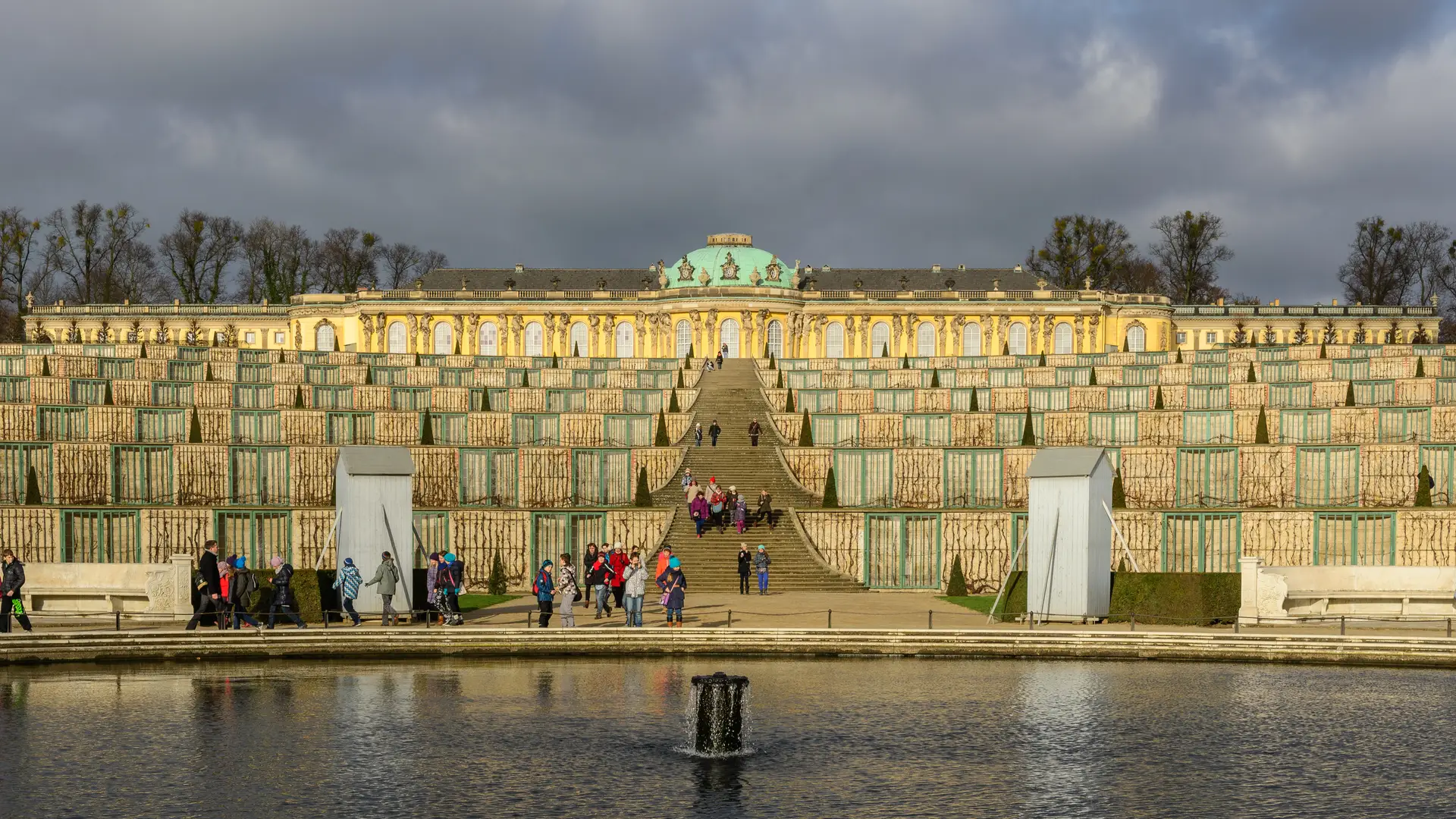
Begin at the eastern end, because that is where the timed entries are strictest and the crowds gather first. Sanssouci Palace crowns the terraced vineyard that Frederick ordered cut into the hillside in 1744, with vines trained against the brickwork and figs in the glazed niches, and a long central stair descending to the Great Fountain. Entry to the palace interior is bound to a fixed admission slot on your ticket, so the practical rhythm is to book the earliest slot you can get, walk the terraces before it, and be inside the ten rooms when your time comes. On the uppermost terrace, a few steps from the east wing, lies Frederick's plain grave slab, usually decorated with flowers and a scatter of potatoes left by visitors; it costs nothing to visit and is often missed entirely by people hurrying to the entrance.
Two substantial buildings sit within five minutes of the palace and are routinely skipped by visitors who do not know what is inside them. East of the palace stands the Picture Gallery, built by Frederick from 1755 to 1763 and regarded as the oldest surviving purpose-built gallery building in Germany; inside hang Caravaggio's Doubting Thomas, five works by Anthony van Dyck, and seven by Rubens, including his St Jerome. West of the palace are the New Chambers, an orangery by Knobelsdorff that Frederick had converted into a guest palace from 1768, with a jasper-lined central hall and a gallery of gilded reliefs illustrating Ovid's Metamorphoses. Both are seasonal, roughly spring to autumn, and both close on Mondays. Above them all turns the Historic Windmill, beside which sits the visitor centre where same-day tickets are sold from half an hour before opening.
The middle distance: the Chinese House and the northern edge
Leaving the vineyard hill westward, the first essential detour comes quickly. A ten-minute walk south-west of the terraces, in its own clearing, stands the Chinese House, the gilded clover-shaped pavilion that is the park's most photographed building after the palace itself. Life-sized gilded sandstone figures of Chinese musicians and tea drinkers, carved by Peter Benckert and Johann Gottlieb Heymueller, sit around the exterior between columns shaped as golden palm trees, and inside, gilded consoles carry a display of eighteenth-century porcelain. Frederick prized the pavilion as an escape into a fantasy world, and it still reads that way: it is a building with no function except delight. The interior is open seasonally from May to October, closed Mondays, but the exterior, which is most of the point, can be admired whenever the park is open.
Along the park's northern edge rises the Orangery Palace, the 300-metre Italianate range built between 1851 and 1864 under Frederick William IV to designs by Persius, Stueler, and Hesse, housing the Raphael Hall with its more than fifty nineteenth-century copies of Raphael paintings. Be aware before you route your day around it: at the time of writing the Orangery Palace is closed for restoration under the long-term masterplan for the Prussian palaces, so the interior, including the tower, is off the itinerary. The long facade and the terraced gardens in front of it remain an impressive sight from the outside, and the path along them is a pleasant alternative to the main avenue for the westward walk. Check the current status before your visit rather than assuming either way; restoration timetables move.
The western and southern reaches: Neues Palais and Charlottenhof
The walk from the vineyard hill to the Neues Palais along the Hauptallee takes 25 to 35 minutes at a sightseeing pace, and the payoff is the second unmissable interior of the park. The Neues Palais, completed in 1769, is everything Sanssouci is not: banquet halls, state galleries, a shell-and-mineral-lined Grottensaal, and the court theatre in the southern wing. Entry is bound to fixed admission times like the main palace, and it keeps a different closing day, shut on Tuesdays where Sanssouci and most of the park's smaller buildings close on Mondays. That asymmetry is the single most common way visitors lose an interior from their day, so check the weekday before you fix your date.
The southern third of the park belongs to a later sensibility. Charlottenhof, the neoclassical villa to the south-west of Sanssouci Palace, was a Christmas present in 1825 to the crown prince who became Frederick William IV; Karl Friedrich Schinkel rebuilt the house and Peter Joseph Lenne shaped the landscape around it from 1826, drawing openly on the excavated villas of Pompeii and Herculaneum, down to a famous blue-and-white striped room fitted out like a tent. It opens seasonally from May to October, closed Mondays, and is visited by guided tour, conducted in German with written information available in other languages. Nearby sit the Roman Baths, part of the same Italian dream, and at the park's south-eastern entrance the Church of Peace, begun in 1845, completes the picture. If your legs have limits, prioritise the Neues Palais and treat the southern buildings as a second-visit reward.
Tickets, structurally: what needs its own entry and what does not
The ticketing logic of the park confuses more visitors than its geography, so here it is in plain terms. The park grounds are free. Every palace interior is ticketed separately, and the two headline interiors, Sanssouci Palace and the Neues Palais, bind entry to a fixed time slot printed on the ticket. The smaller seasonal buildings, the Picture Gallery, the New Chambers, the Chinese House interior, and Charlottenhof, each admit with their own ticket during their open months. Alternatively, a combined day ticket, sold as sanssouci+, covers a single visit to all the Potsdam palaces open to the public on one day and includes the fixed admission slots for both Sanssouci Palace and the Neues Palais; it is not valid for special exhibitions or for a couple of outlying properties. Which arrangement suits you depends entirely on appetite: one interior, buy that interior; two or more, the day ticket usually earns its keep in convenience alone.
A workable gold-standard route, for the record: arrive before opening and walk the terraces; take the first Sanssouci Palace slot at 10:00; see the Picture Gallery or the New Chambers immediately after; detour to the Chinese House on the way west; pass the Orangery facade; reach the Neues Palais for an early-afternoon entry; then either loop back through Charlottenhof and the Roman Baths or leave the park at its western end. That sequence covers roughly five kilometres of walking across a full day, never retraces a path, and puts you at each timed door in the order the slots naturally fall. Wear real shoes, carry water in summer, and remember that prams are not permitted inside the palace rooms for conservation reasons, one of several small rules that are easier to know before you are standing at a door.
Frequently asked
How big is Sanssouci Park and how long does it take to walk?
The park covers nearly 300 hectares with an east-west axis of more than two kilometres. Walking from Sanssouci Palace to the Neues Palais takes 25 to 35 minutes without stops; a full day covering the main buildings involves roughly five kilometres on foot.
Is Sanssouci Park free to enter?
Yes. The park is open daily from 8 am until dark and entry to the grounds is free. Only the building interiors are ticketed, and the two main palaces bind entry to fixed time slots.
Do all the palaces in the park need separate tickets?
Each interior admits with its own ticket, or a combined day ticket covers a single visit to all the Potsdam palaces open to the public on one day, including the fixed time slots for Sanssouci Palace and the Neues Palais.
Is the Orangery Palace open?
At the time of writing the Orangery Palace is closed for restoration under the long-term masterplan for the Prussian palaces. The 300-metre facade and the terraced gardens in front of it can still be seen from the park.
Which buildings close on Mondays?
Sanssouci Palace, the Picture Gallery, the New Chambers, the Chinese House, and Charlottenhof all close on Mondays. The Neues Palais closes on Tuesdays instead, which is the most common scheduling trap in the park.
Where is Frederick the Great's grave?
On the uppermost vineyard terrace beside the palace's east wing, marked by a plain stone slab where visitors leave flowers and potatoes. It sits in the free part of the park and needs no ticket.