 Skip-the-line available
 How Sanssouci Entry Actually Works: Slots, Hours, and Closures
Fixed admission times, a park that opens two hours before the palace, a photo permit most visitors have never heard of, and two different weekly closing days. The mechanics, decoded.
Sanssouci is not a walk-up attraction, and the visitors who have a bad day there are almost always the ones who assumed it was. The palace admits on fixed time slots with a limited daily quantity, the park and the palace keep entirely different hours, the buildings scattered across the grounds follow at least three different seasonal calendars, photography inside requires a permit that must be bought separately, and the two headline palaces close on different days of the week. None of this is complicated once laid out, but almost none of it is obvious from the gate. This guide walks through the machinery, hours, slots, closing days, the combined day ticket, and the small rules, so that the only surprises left on the day are the pleasant kind.
Timed entry: how the slot system works
Entry to Sanssouci Palace is bound to a fixed admission time. Your ticket carries a specific date and a specific slot, and you enter the ten-room enfilade within that window, not before and not after. The system exists because the palace is small, a single storey that admits visitors in metered pulses to protect both the rooms and the experience, and it has a hard consequence: the number of tickets per day is limited, and on summer days the allocation can be gone before lunchtime. The reliable pattern is to secure your slot in advance online rather than gambling on the door, and to treat the earliest slots as the premium ones, since mornings are quieter and leave the whole day open for the rest of the park.
Same-day tickets do exist. They are sold at the visitor centre at the Historic Windmill, beside the palace, from 30 minutes before opening, and on a shoulder-season weekday you may get exactly the slot you want that way. In high season you are more likely to be offered mid-afternoon, or nothing. Two further mechanics worth knowing: last admission is 30 minutes before closing, so a late slot compresses the visit, and the tour itself is self-guided, paced by you rather than by a group, with a free multimedia guide app available in twelve languages plus children's versions. Arrive at the palace door a few minutes before your printed time, with the ticket on your phone, and the rest is painless.
How far ahead is far enough? There is no single answer, because demand moves with the calendar, but the pattern is consistent. Peak-summer weekends, holiday weeks, and any sunny Saturday between May and September are the dates on which the morning slots vanish first and the day can sell through entirely; for those, book as soon as your travel date is firm. Shoulder-season weekdays are forgiving, and deep winter rarely sells out at all, though the shorter opening day tightens the slot spread. The one habit to avoid is the reverse commute: visitors who arrive slotless at noon in July and are offered 16:00, then spend four hours filling time they had planned to spend inside palaces, have not saved anything by waiting. The slot is the skeleton of a Sanssouci day; fix it first and hang everything else, trains, lunch, the long park walk, off that fixed point.
Park hours versus palace hours
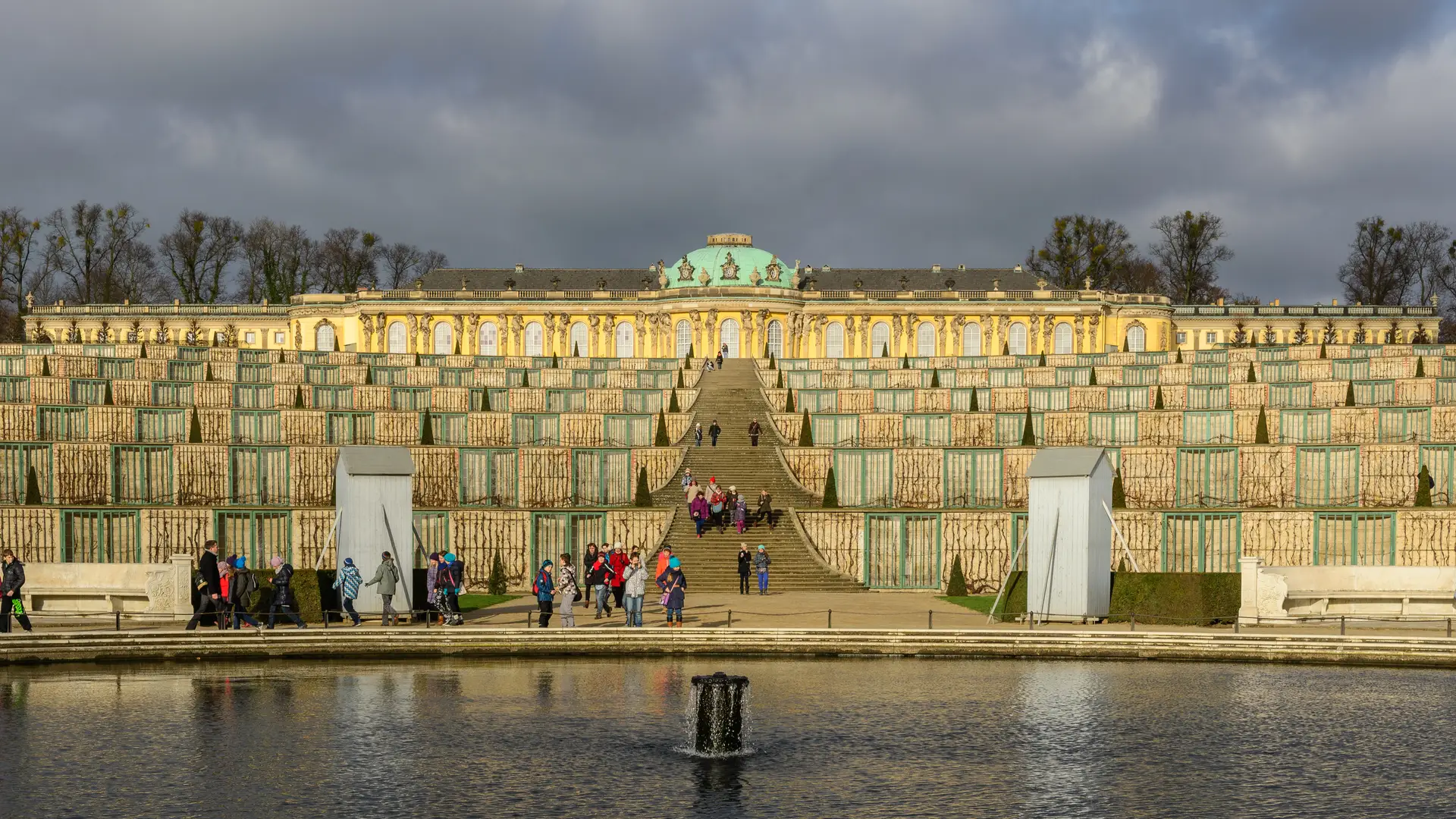
The single most useful scheduling fact at Sanssouci is that the park and the palace run on different clocks. The park opens at 8 in the morning and stays open until dark, every day of the year, free of charge. The palace interior opens at 10:00, closing at 17:30 in the main season from April to October and at 16:30 in the winter months, with Mondays off. That two-hour gap in the morning is a gift: the vineyard terraces, the Great Fountain, Frederick's grave slab on the upper terrace, and the long avenues can all be seen before the first slot of the day is called, in the emptiest, best-lit hours the park has.
The smaller buildings layer a third calendar on top. The Chinese House, the Picture Gallery, and Charlottenhof open only from May to October; the New Chambers run April to October; and all of them keep the 10:00 to 17:30 rhythm with Mondays closed. The Orangery Palace is currently closed altogether for long-term restoration. In practice this means a winter visit is a two-interior day at most, palace plus Neues Palais, wrapped in a park that is atmospheric and nearly empty, while a June visit can fill an entire day with interiors alone. Neither is the wrong choice; they are simply different products, and knowing which one your date buys you is half the planning.
The Monday trap, and the Tuesday one
Sanssouci Palace closes on Mondays, every week, year round. So do the Picture Gallery, the New Chambers, the Chinese House interior, and Charlottenhof. A visitor who arrives in Potsdam on a Monday finds the park open and beautiful and nearly every door in it shut. This is the single most common planning failure at Sanssouci, and it has a mirror image: the Neues Palais, the park's other essential interior, takes its weekly closing day on Tuesday instead, and is open on Mondays. The asymmetry is easy to remember once stated, Sanssouci rests Mondays, the Neues Palais rests Tuesdays, but it silently reshapes an itinerary: a Monday visitor can still have a full palace experience at the western end of the park, and a Tuesday visitor must accept the reverse.
For anyone with a flexible date, the ranking follows automatically. Wednesday through Sunday, every building keeps its normal schedule and the whole park is available. Monday sacrifices Sanssouci itself, which for a first visit is usually disqualifying. Tuesday sacrifices the Neues Palais, a real loss but a survivable one. Public holidays follow their own arrangements, and restoration programmes can take individual buildings offline for seasons at a time, the Orangery Palace being the current example, so the final check of current opening days belongs in everyone's last week of planning, whatever the day of travel.
One ticket or several: the day ticket, structurally
Every interior in the park admits with its own ticket, so a day of three buildings can mean three separate transactions, two of them slot-bound. The alternative is the combined day ticket, sold under the name sanssouci+, and its structure is worth understanding precisely. It covers a single visit to each of the Potsdam palaces open to the public on one calendar day, and it includes the fixed admission slots for the two palaces that require them, Sanssouci and the Neues Palais. It is valid as a smartphone voucher without a printout. Its edges: it does not cover special exhibitions, two outlying properties, Sacrow House and the Stern Hunting Lodge, sit outside it, and at the Belvedere on the Pfingstberg it earns a reduced rate rather than free entry. A family version admits up to two adults and four children on the same terms.
The decision rule is appetite. A visitor who wants only the ten rooms of Sanssouci buys the single palace ticket and is done. A visitor intending two or more interiors, which describes almost everyone who has read this far, is usually better served by the day ticket, less for arithmetic than for friction: one purchase, both slots fixed in the same transaction, and no ticket-desk stop at each subsequent door. Whichever route you take, the slots for Sanssouci itself remain the scarce resource in the system, so the day ticket is not a substitute for booking ahead on busy dates; it is a container for the same scarce slot, bundled with everything else.
A worked example makes the structure concrete. Suppose a Thursday in June, with ambitions on the palace, the Picture Gallery, and the Neues Palais. On single tickets, that is three purchases, two of them slot-bound, ideally the palace at 10:00 and the Neues Palais mid-afternoon, with the gallery slotted freely between. On the day ticket, it is one purchase carrying both fixed slots plus open admission to the gallery and to anything else stamina permits, the New Chambers, the Chinese House interior, Charlottenhof by tour. The day ticket also quietly insures the itinerary: if the gallery queue or a long lunch reshuffles the afternoon, the untimed buildings flex around the two fixed slots without any ticket consequences. What it does not do is bend the fixed slots themselves, and it expires with the calendar day, so the classic error of trying to stretch it across a two-day visit fails at the second morning's first door.
Photo permits, prams, and the other small print
Photography inside the palaces is the rule that ambushes the most visitors. Taking pictures in the interiors for private use is allowed, but it requires a photo permit, a separate paid pass valid for the day across the palaces, and it comes with conditions: no flash and no tripods. The permit is bought alongside your ticket rather than at the room door, so decide before you enter whether the interiors are a photography project or a memory project. Outside, in the park, no permit is needed for ordinary visitor photography, and the terraces at golden hour will fill a camera roll more generously than the lacquered rooms in any case. If interior shots matter to you, the permit question is worth settling at the moment of booking rather than at the door, because retrofitting it mid-visit means leaving the queue you worked to be early in. Serious photography with professional intent sits outside the visitor permit altogether and needs prior arrangement with the palace administration, a different process entirely.
The remaining small print is brief but firm. Prams and strollers cannot be taken into the palace rooms, a conservation rule that families should plan around rather than discover at the threshold. Assistance dogs are welcome. Large bags are impractical in a single-file enfilade of small rooms and are best not brought. And the terraces deserve a footwear warning that sounds trivial until the day turns wet: the historic steps and paths are stone and gravel on a real slope. None of these rules is onerous. Collectively they express what Sanssouci is, a small, fragile, over-loved building that survives its two-and-a-half centuries of admirers by metering them carefully, and a visitor who works with the metering rather than against it gets the palace at its best.
Frequently asked
Is Sanssouci Palace open on Mondays?
No. The palace closes every Monday, along with the Picture Gallery, the New Chambers, the Chinese House, and Charlottenhof. The Neues Palais closes on Tuesdays instead and is open on Mondays.
What are Sanssouci's opening hours?
The palace opens Tuesday to Sunday from 10:00, closing at 17:30 from April to October and 16:30 in the winter months, with last admission 30 minutes before closing. The park itself is open daily from 8 am until dark, free of charge.
Can I buy a ticket on the day?
Same-day tickets are sold at the visitor centre by the Historic Windmill from 30 minutes before opening, but the daily allocation is limited and summer days can sell through. Booking a slot in advance is the reliable route.
Do I have to join a guided tour?
No. Sanssouci Palace is visited self-guided within your admission slot, with a free multimedia guide app offered in twelve languages plus children's versions. Charlottenhof, by contrast, is seen by guided tour.
Can I take photos inside the palace?
Yes, for private use, but only with a photo permit valid for the day, and without flash or tripods. No permit is needed for photography outside in the park.
What does the sanssouci+ day ticket include?
A single visit to each of the Potsdam palaces open to the public on one day, including the fixed admission slots for Sanssouci Palace and the Neues Palais. It excludes special exhibitions, Sacrow House, and the Stern Hunting Lodge, and grants a reduced rate at the Pfingstberg Belvedere.