 Skip-the-line available
 Potsdam in a Day: Sanssouci, the Park, and the Dutch Quarter
Twenty-five minutes on a train buys you a royal park, two palaces, and the largest Dutch quarter outside the Netherlands. The hour-by-hour version of the day that works.
Potsdam is the best-value day trip in Germany and one of the most commonly botched. The raw materials are absurd: a UNESCO World Heritage landscape of 500 hectares of parks and 150 royal buildings, a compact baroque town centre with a red-brick Dutch quarter unique on the continent, and all of it 25 minutes by regional train from Berlin Hauptbahnhof on an ordinary city transit ticket. The botching happens through sequencing, arriving at noon to find the palace slots gone, walking the two-kilometre park backwards, or spending the golden last hours of the day on a station platform instead of in a cafe under Dutch gables. What follows is the sequence that works, hour by hour, with the decision points named, including what to do about Cecilienhof, the third famous palace, which is currently closed for restoration and needs an honest word rather than a stale recommendation.
Getting there: the 25-minute head start
The single best decision of the day is taken in Berlin: ride the RE1 regional express from Berlin Hauptbahnhof, which reaches Potsdam Hauptbahnhof in about 25 minutes, rather than defaulting to the S-Bahn, which takes the better part of an hour from central Berlin. Both run on the same VBB ABC day ticket, so the faster train carries no fare penalty, and the RE1 departs roughly every half hour. The S7 remains the fallback when timings do not line up, direct and frequent, just slower. Either way, buy the ABC day ticket rather than singles; it covers the trains out, every bus and tram inside Potsdam, and the ride home, and it removes ticket friction from the whole day.
From Potsdam Hauptbahnhof, the palace is a further 2.5 kilometres north-west, and the connection is bus 695 from the station forecourt, the dedicated palace line, which reaches the Schloss Sanssouci stop in about 15 minutes and is covered by the same day ticket. The arithmetic of the morning follows backwards from the palace's first admission slot at 10:00: an RE1 out of Berlin a little after 9:00 puts you on the hill in comfortable time, and an earlier train buys you the park at its emptiest, since the grounds open at 8 and the two hours before the palace door opens are the best walking hours Sanssouci has. Aim early; the whole day downstream gets easier.
Morning: Sanssouci at opening
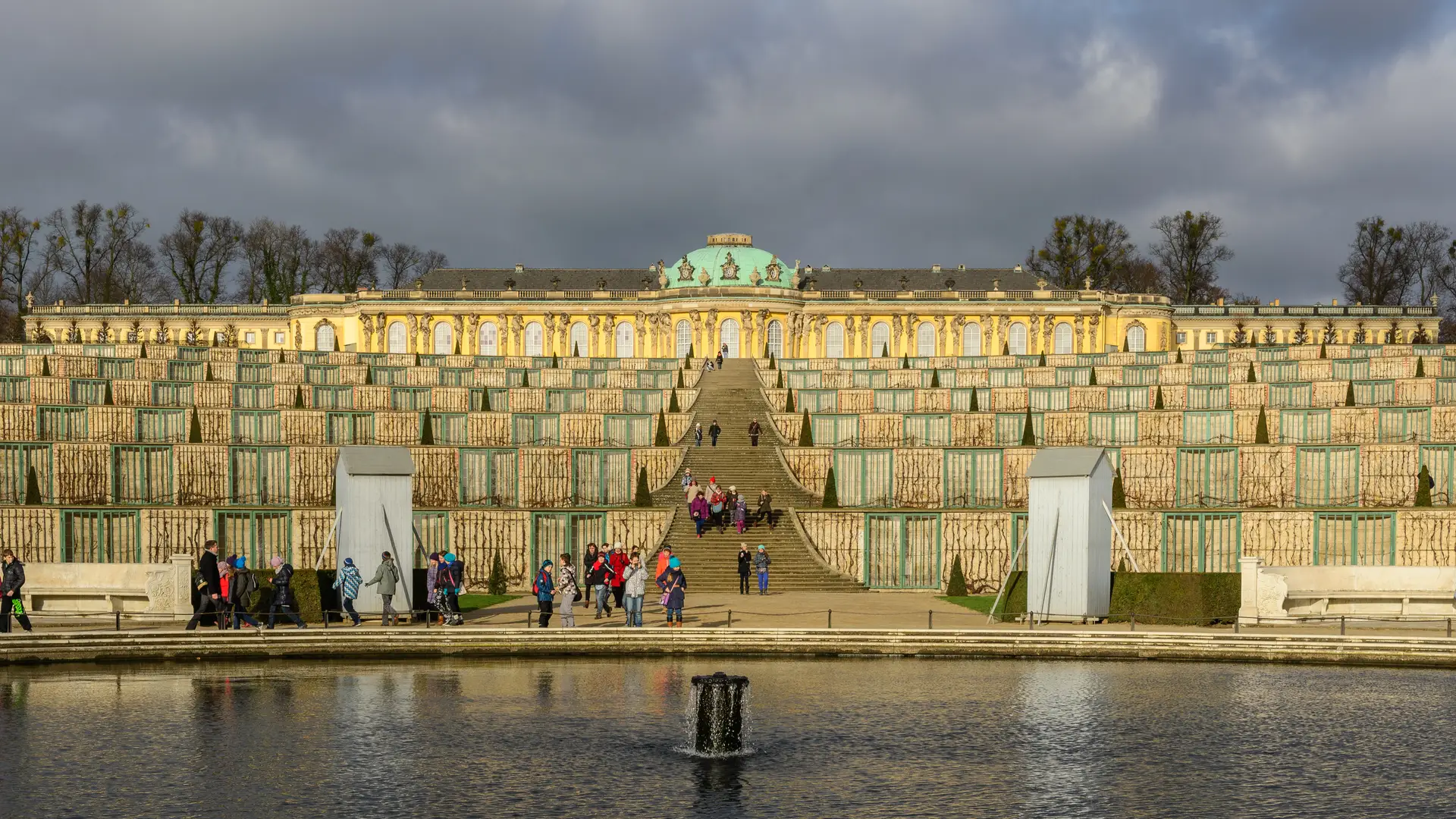
Take the earliest palace slot you can get, ideally the 10:00, booked in advance rather than gambled on at the door, since daily ticket numbers are limited and summer allocations go early. Before your time is called, spend the spare half hour on the terraces: the vineyard falls away in curved tiers below the palace, the Great Fountain runs at the bottom of the axis, and on the uppermost terrace, a few steps from the east wing, lies Frederick the Great's plain grave slab with its scatter of visitor-left potatoes, the most quietly moving thing in the park and entirely free to see. The palace interior itself, ten Rococo rooms visited self-guided with a free app, takes 45 minutes to an hour at an unhurried pace.
Directly after the palace, while you are still on the hill, collect one of its two flanking buildings, both within five minutes' walk and both closed on Mondays like the palace itself. The Picture Gallery, to the east, built from 1755 to 1763 and the oldest surviving purpose-built gallery in Germany, hangs Caravaggio's Doubting Thomas alongside works by Rubens and van Dyck in a single gilded hall; the New Chambers, to the west, answer with the Jasper Hall and a gallery of gilded Ovid reliefs. One is enough on a day trip; the gallery has the stronger claim for most visitors. By late morning you should be walking west with the vineyard hill behind you.
A word on the fallback if the advance slots are gone or your plans firmed up late: same-day tickets are sold at the visitor centre by the Historic Windmill, next to the palace, from 30 minutes before opening. On a day-trip timeline this is a genuine option only if you commit to it properly, meaning the earlier train and a position near the front of the queue before 9:30, because the daily quantity is limited and what remains by mid-morning tends to be afternoon slots that wreck the westward sequence. If the windmill desk offers you nothing before 15:00, invert the day rather than abandoning it: walk west immediately, take the Neues Palais and the park in the morning and midday, and return to the vineyard hill for the late slot, accepting the doubled distance as the price of the late start. The itinerary survives inversion; it just prefers not to need it.
Midday: the long walk west to the Neues Palais
The walk from Sanssouci to the Neues Palais along the park's main axis takes 25 to 35 minutes, and done properly it is a highlight rather than a transfer. Detour first to the Chinese House, ten minutes south-west of the terraces: a gilded pavilion ringed by life-sized golden figures of musicians and tea drinkers under palm-tree columns, Frederick's built fantasy world and the park's most photogenic small building. Its interior, a porcelain cabinet, opens May to October, but the exterior carries the visit in any season. Rejoining the westward line, the 300-metre facade of the Orangery Palace runs along the park's northern rise; the interior is currently closed for restoration under the palaces masterplan, so admire the Italianate front from the gardens and keep walking rather than routing your day around it.
Enter the Neues Palais in the early afternoon. Frederick's 200-room statement piece, finished in 1769 to announce that the Seven Years' War had not broken Prussia, is the day's second essential interior and its complete tonal opposite: the shell-and-mineral Grottensaal, the marble galleries, and the court theatre in the south wing, all at a scale the vineyard palace deliberately refused. Entry is bound to fixed admission times, and the crucial calendar fact is that it closes on Tuesdays, where Sanssouci closes on Mondays, so a Wednesday-to-Sunday trip gets both while a Monday or Tuesday trip must choose. Allow a solid 90 minutes inside. Afterwards you are at the park's western end, which is exactly where you want to be for the afternoon pivot into town.
Afternoon: the Dutch Quarter and the old town
From the park, ride back east into the town centre, tram and bus connections run on your day ticket, and give the last full block of the afternoon to the Hollaendisches Viertel, the Dutch Quarter. It is a genuine curiosity: 134 red-brick gabled houses arranged around four squares along Mittelstrasse, built between 1733 and 1742 by the Dutch master builder Jan Boumann for the Dutch craftsmen King Frederick William I hoped to settle in his garrison town, and the largest ensemble of Dutch-style housing outside the Netherlands. Where the morning belonged to kings, the quarter is domestic Potsdam, two-storey brick, white joints, steep gables, and its ground floors have filled with cafes, boutiques, and galleries that make it the town's natural coffee-and-wander district. It sits by the Nauener Tor, one of the old city gates, and an hour here with a pastry is the correct decompression after eight kilometres of royal landscape.
If the legs still have credit, the surrounding old town rewards another half hour: the rebuilt baroque centre around Brandenburger Strasse, Potsdam's own little Brandenburg Gate at its western end, and the domed St Nicholas Church on the Alter Markt near the rebuilt City Palace. None of it needs a ticket or a plan; it is strolling territory, and it corrects the common Berlin-visitor impression that Potsdam is only a park with palaces in it. The town was a royal residence city for two centuries, and the fabric, Dutch, baroque, and neoclassical in adjacent streets, is the evidence. Dinner in the Dutch Quarter before the train home is the natural full stop; Potsdam Hauptbahnhof is a short tram hop away, with the RE1 and S7 running into the Berlin evening. Two closing habits keep the exit graceful. First, check the evening RE1 departures before sitting down to eat, because the half-hourly rhythm means a missed train costs real time at the end of a long day, and the S7 fallback, though frequent, adds most of half an hour to the ride. Second, resist the urge to squeeze one more sight into the dusk: the day described here already covers eight to ten kilometres on foot, and its correct final scene is a table under the gables, not a jog to a closing door. Potsdam repays a second visit; it does not require the first one to be exhaustive.
The Cecilienhof question, answered honestly
Every Potsdam itinerary written in the last decade pairs Sanssouci with Schloss Cecilienhof, and the pairing made sense: the Tudor-style country house in the Neuer Garten, built 1913 to 1917 as the last palace of the Hohenzollerns, is where Churchill, Truman, and Stalin sat down from 17 July to 2 August 1945 and redrew Europe at the Potsdam Conference. It is the twentieth-century counterweight to Frederick's eighteenth, and on a two-day visit it would be unmissable. The honest current status, however, is that Cecilienhof is closed for restoration under the long-term masterplan for the Prussian palaces, with the conference rooms explorable virtually through Google Arts and Culture in the meantime. Building a day-trip hour around a closed door is how afternoons die; check the current status if your visit is months away, and otherwise plan around it.
This is why the Dutch Quarter, not Cecilienhof, anchors the afternoon of this itinerary. The substitution costs the day its Cold War chapter but keeps its rhythm intact, and the Neuer Garten itself, the lakeside landscape park around Cecilienhof, remains open like all Potsdam's parks for anyone determined to see the house's Tudor chimneys from the outside. Travellers with a deep 1945 interest have a better move: keep the Potsdam day for the palaces and the town, and take the S-Bahn one stop across the Glienicke Bridge, the actual bridge of spies, whose Cold War history is readable from the footpath at any hour. The conference rooms will reopen; the day trip should not wait for them.
Frequently asked
How do I get from Berlin to Sanssouci?
Take the RE1 regional express from Berlin Hauptbahnhof to Potsdam Hauptbahnhof, about 25 minutes, on a VBB ABC day ticket, then bus 695 from the station to the Schloss Sanssouci stop in about 15 minutes. The S7 S-Bahn is the slower direct alternative.
Is one day enough for Potsdam?
Enough for the essentials done well: Sanssouci Palace at opening, one flanking building, the park walk west, the Neues Palais, and the Dutch Quarter. A second day would add Charlottenhof, the Roman Baths, and the Neuer Garten at leisure.
Which day of the week is best?
Wednesday to Sunday. Sanssouci Palace and most park buildings close on Mondays, and the Neues Palais closes on Tuesdays, so only midweek-to-weekend dates give you both palaces on one trip.
Is Cecilienhof open?
At the time of writing Cecilienhof is closed for restoration, with the Potsdam Conference rooms viewable virtually via Google Arts and Culture. The surrounding Neuer Garten park remains open. Check the current status before building your day around it.
What is the Dutch Quarter?
Four squares of 134 red-brick gabled houses around Mittelstrasse, built 1733 to 1742 by Jan Boumann for Dutch craftsmen invited by King Frederick William I, and the largest Dutch-style ensemble outside the Netherlands. Today it is Potsdam's cafe and boutique district, beside the Nauener Tor.
Do I need to book Sanssouci in advance for a day trip?
Strongly advisable. Palace entry is bound to fixed time slots with a limited daily quantity, and on busy days the allocation sells through. An advance slot at or near 10:00 is the keystone the whole itinerary hangs on.